When Your Inner Critic Is Loudest at Night
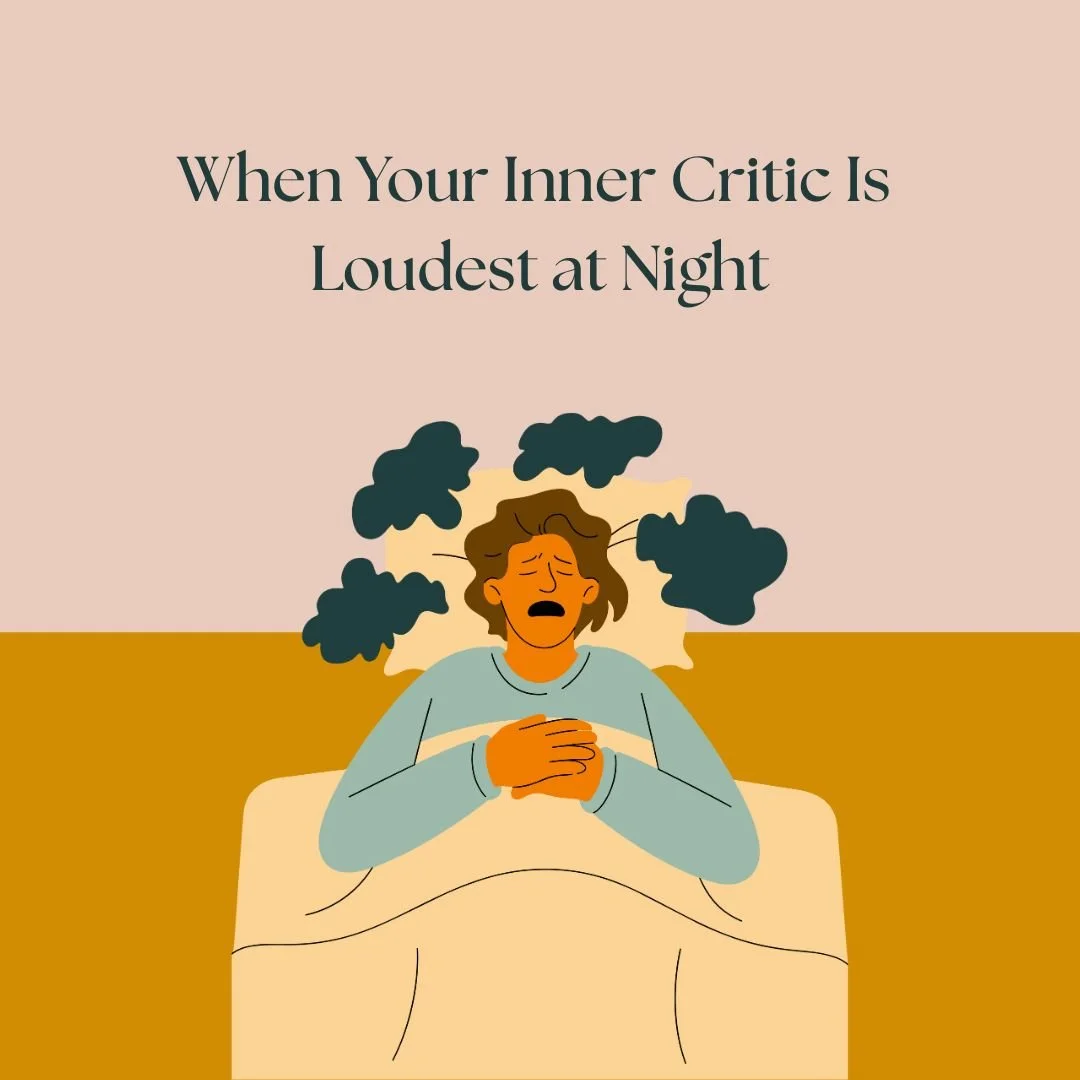
It’s 11:47pm.
You’re exhausted.
You brushed your teeth.
You got into bed at a reasonable time.
And suddenly your brain says:
“Hey. Before we sleep… Let’s review every awkward thing you’ve ever said.”
Cool. Love that.
If you’ve ever noticed your self-talk getting harsher at night — you’re not dramatic, broken, or uniquely bad at relaxing.
There are actual psychological and nervous system reasons this happens.
Let’s break it down.
Why Self-Talk Gets Worse at Night
1️⃣ There Are Fewer Distractions
During the day, your brain is busy:
Emails
Clients
Deadlines
Conversations
Traffic
Tasks
At night?
Silence.
When external stimulation decreases, internal stimulation increases. The thoughts that were waiting in line finally get the microphone.
2️⃣ You’re Mentally Tired
Fatigue weakens emotional regulation.
When you’re tired:
Your prefrontal cortex (logic, reasoning, perspective) is less effective.
Your amygdala (threat detection) is more reactive.
Translation: your brain is more likely to interpret neutral things as problems.
That slightly awkward comment from 2pm? Now it’s a character flaw.
That unfinished task? Now it’s proof you’re behind in life.
Exhaustion makes everything louder.
3️⃣ The Brain Defaults to “Problem-Solving Mode”
Your brain does not power down just because you turned off the lights.
When the day slows, your mind often shifts into:
Reviewing
Planning
Scanning for threats
Trying to prevent future mistakes
…Which can quickly turn into rumination.
Reflection vs. Rumination
Not all nighttime thinking is bad.
Reflection sounds like:
“I didn’t love how I handled that. I’ll try something different tomorrow.”
Rumination sounds like:
“Why am I like this?”
“I always mess things up.”
Replay. Replay. Replay.
Reflection moves forward.
Rumination loops.
Your nervous system can’t tell the difference between replaying embarrassment and reliving danger. So it reacts — tight chest, racing thoughts, restlessness.
The Nervous System Factor
Nighttime can amplify vulnerability.
You’re alone.
It’s dark.
Your body is trying to downshift.
For some people, that downshift actually feels unsafe.
If you grew up needing to anticipate problems, your system may equate quiet with “scan harder.”
So your inner critic steps in, believing it’s helping you prepare.
It’s misguided protection.
What Actually Helps When You’re Spiraling at Night
Here are strategies that tend to work better than “just stop thinking about it.”
✔ Externalize the Thoughts
Write them down.
Not to solve them — just to contain them.
Think of it like this — When thoughts live only in your head, they expand. On paper, they shrink.
✔ Schedule Worry Time Earlier
If you tend to process late at night, try setting aside 10–15 minutes in the afternoon labeled:
“Intentional Overthinking Time.”
Let your brain review things then.
It’s less likely to hijack bedtime if it knows it has a slot.
✔ Use Audio Input
Give your brain something neutral to focus on:
A podcast you’ve already heard
An audiobook
Calm music
White noise
Input competes with rumination.
✔ Change the Language
Instead of:
“Why am I like this?”
“This is bad.”
“I can’t believe I did that.”
Try containment phrases:
“Not useful right now.”
“Tomorrow’s brain can handle this.”
“I’m allowed to sleep.”
We’re not arguing with the thought. We’re postponing it.
A Gentle Reality Check
If your nighttime anxiety is chronic — meaning you dread going to bed because you know the spiral is coming — that’s worth paying attention to.
Sometimes loud nighttime self-talk is connected to:
Anxiety disorders
Perfectionism
Trauma patterns
Chronic stress
And those patterns don’t fix themselves with better sleep hygiene alone.
You’re Not Broken. You’re Wired for Survival.
Your brain thinks it’s helping.
It believes: “If I review everything, we won’t get hurt again.”
But safety doesn’t come from 90 minutes of self-criticism under the covers.
It comes from learning how to relate to your thoughts differently.
And that’s a skill. Not a personality trait.
If this sounds familiar, you’re not alone in it. And you don’t have to untangle it by yourself.