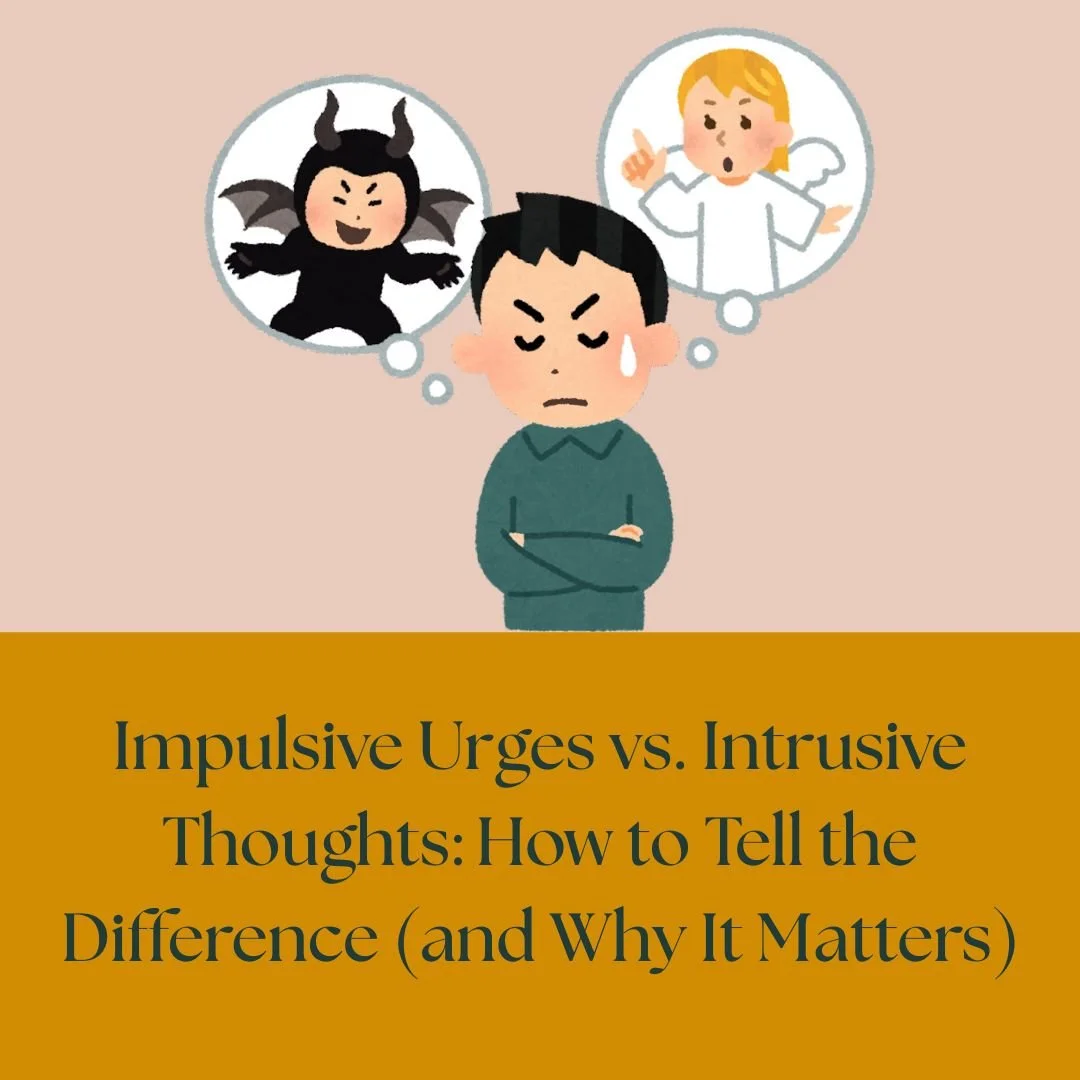
Impulsive Urges vs. Intrusive Thoughts: How to Tell the Difference (and Why It Matters)
If you’ve ever wondered, “Why did I just think that?” or “Why do I feel the sudden urge to do that?” — you’re not alone.
Our minds can serve up all kinds of spontaneous experiences: fleeting ideas, strong urges, vivid images, or random “what if” thoughts that come out of nowhere.
But not all mental blips are the same. In therapy, I often help clients learn the difference between impulsive urges and intrusive thoughts — two experiences that can feel similar on the surface but come from very different places.
Let’s unpack the difference.
What Are Impulsive Urges?
Impulsive urges are exactly what they sound like — impulses to act. They’re usually short-lived behavioral urges that pop up quickly and fade just as fast.
They’re often not inherently harmful (though sometimes they can be risky or unhelpful), and they don’t usually cause ongoing distress. They’re more about behavior than belief — a “what if I did this right now?” moment.
Common Examples of Impulsive Urges:
Wanting to dye or cut your hair on a whim
Considering eating the whole pint of ice cream
Wondering if you can fit the entire muffin in your mouth (we’ve all been there)
Deciding to go out drinking on a weekday
Impulsive urges can be linked to emotions, boredom, or even just curiosity. They often pass quickly once the feeling or situation changes.
What Are Intrusive Thoughts?
Intrusive thoughts, on the other hand, are unwanted, repetitive thoughts or images that tend to stick around.
They’re not something you want to think or act on — in fact, they usually cause distress, anxiety, or shame precisely because they go against your values or sense of self. Intrusive thoughts can be hard to control and may repeat in a loop, especially when you try to push them away.
Common Examples of Intrusive Thoughts:
“What if I just drove right off this bridge?”
“Am I actually about to die from salmonella after eating that cookie dough?”
“Have I tricked my therapist into thinking I’m doing better than I am?”
“What if I cheat on my partner?”
“Maybe God doesn’t actually exist.”
These kinds of thoughts are normal to have occasionally — everyone’s brain throws out weird, sometimes dark ideas. But when they become distressing or frequent, they can show up in conditions like OCD, anxiety disorders, or postpartum anxiety.
Why It’s Important to Tell the Difference
When people don’t understand the difference between impulsive urges and intrusive thoughts, they can end up feeling deep shame, fear, or guilt about what’s happening in their mind.
Someone with intrusive thoughts might worry, “Does this mean I secretly want to act on this?” — when in reality, the distress they feel is the biggest indicator that they don’t.
On the flip side, impulsive urges are often acted on without much thought — which is why learning to pause and check in before reacting can help prevent regret-driven decisions.
Understanding which is which matters for a few reasons:
🧠 It reduces self-stigma. Knowing that intrusive thoughts don’t define who you are can help you approach them with compassion rather than fear.
💬 It improves communication. Being able to describe your experience clearly (e.g., “I’m having intrusive thoughts about driving off the bridge” vs. “I have an urge to act impulsively when I’m anxious”) helps therapists, friends, or loved ones support you more effectively.
⚖️ It guides appropriate coping. Impulsive urges often respond well to grounding, delaying, or distraction techniques; intrusive thoughts benefit more from acceptance-based approaches and exposure strategies.
When to Reach Out for Support
If intrusive thoughts or impulsive urges are causing distress, affecting your functioning, or leading to harmful behaviors, it might be time to talk to a mental health professional.
Therapy can help you learn strategies to manage impulsivity, reduce obsessive thinking patterns, and build a more compassionate relationship with your mind.
You don’t need to navigate it alone — and you’re definitely not “crazy” for having weird or unwanted thoughts. You’re just human.