Trying to Catch It Before It Catches You: When Relationship Anxiety Becomes Hypervigilance
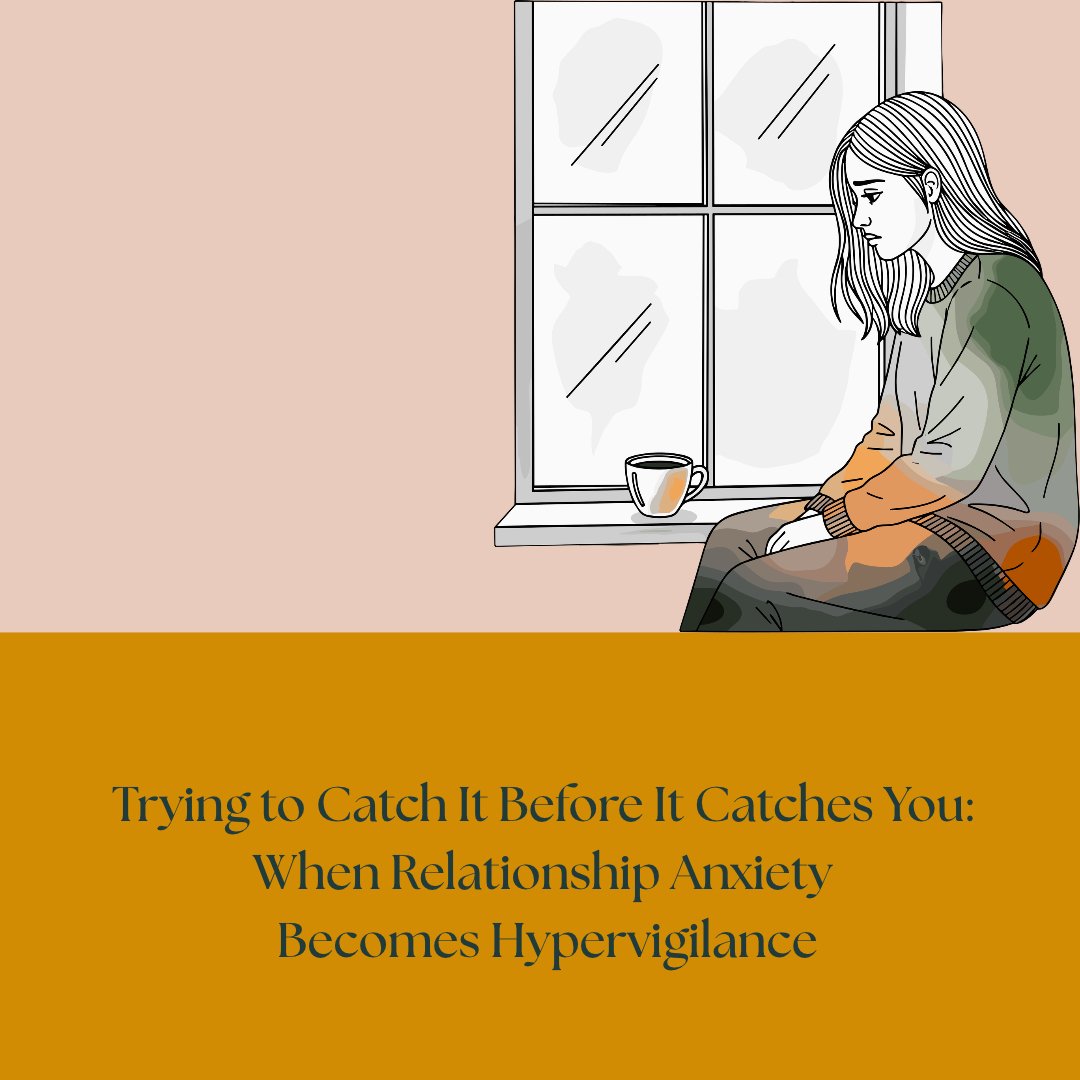
You notice a shift in their tone. They take longer than usual to reply. Their phone is face-down on the table.
And suddenly, your mind is working overtime.
What does that mean? Should I ask? Should I check? If something is wrong, I need to know before I am blindsided.
For many people, this is not simply “being paranoid” or “overthinking.” It is an attempt to protect the heart. The thinking often goes something like: If I figure it out first, I will not be made a fool of. If I can see it coming, it will not hurt as much. If I stay alert enough, I can keep myself safe.
That makes emotional sense. It is also an exhausting job to assign yourself.
The wish underneath the worry
When a relationship matters deeply, uncertainty can feel intolerable. Our brains prefer a painful certainty to an unknown possibility, especially when past experiences have taught us that people can be unpredictable, unavailable, or dishonest.
So the nervous system tries to get ahead of the pain. It scans for clues, replays conversations, searches for inconsistencies, asks for reassurance, checks social media, tests a partner’s devotion, or imagines every possible outcome. In attachment language, this can look like a hyperactivated attachment system: a heightened sensitivity to possible signs of rejection, abandonment, or disconnection.
This does not mean something is wrong with you, nor does it mean you are “too much.” It means your brain has learned that vigilance may be necessary for protection.
The problem is that vigilance often offers only a brief sense of relief—and then asks for more. Research on relationship-based anxiety identifies patterns such as excessive reassurance-seeking and accommodation between partners as common ways anxiety can become embedded in the relationship. A study of relationship-based anxiety found that targeted psychoeducation reduced reassurance-seeking and self-silencing among participants.
Knowing first will not make the loss painless
There is an understandable fantasy at the center of hypervigilance: If I discover the betrayal, rejection, or loss first, I will have the upper hand.
But being prepared for pain is not the same as being protected from pain.
If a feared outcome actually occurs, it may still hurt—deeply. You may be glad to have accurate information, but the hours, days, or months spent monitoring will not have made the event less meaningful. More often, hypervigilance means you experience the pain repeatedly in advance: once in imagination, again in your checking, and perhaps again if the feared event happens.
In other words, anxiety can make you pay for a future that may never arrive.
There is also a difference between insight and surveillance. Insight says, “I notice a pattern that concerns me, and I will respond to the information I actually have.” Surveillance says, “I must keep looking until I can eliminate every possibility of being hurt.” The first is grounded in self-trust. The second is an impossible attempt to control another person and the future.
The costs of trying to be “the wiser one”
Hypervigilance does not happen because someone wants to damage their relationship. It happens because they want to preserve it. Yet the strategies meant to create safety can unintentionally create distance.
Repeated checking, questioning, testing, or seeking reassurance can leave both partners caught in an anxiety cycle:
A trigger appears: a delayed response, a change in routine, a vague feeling.
Anxiety interprets it as danger.
You investigate, question, seek reassurance, or mentally review the evidence.
You feel briefly calmer.
The relief fades, and your brain learns, Checking must be necessary. Do it again next time.
Over time, the relationship can start to revolve around proving safety instead of experiencing connection. A partner may feel scrutinized, defensive, or unable to do anything “right.” Meanwhile, the anxious person may feel temporarily soothed but never genuinely secure.
This is not about blaming the person who is anxious for another person’s harmful choices. If someone lies, cheats, manipulates, or violates agreements, that behavior is their responsibility. Hypervigilance does not cause betrayal.
But anxiety-driven behavior can still affect the emotional climate of a relationship. And it can pull you away from the kind of partner—and person—you want to be: open, direct, self-respecting, and connected to your own life.
You cannot mind-read your way into security
Our minds are excellent storytellers. When anxious, we may mistake a thought for a fact:
“They seem distracted” becomes “They are losing interest.”
“They did not answer for two hours” becomes “They are hiding something.”
“I have a bad feeling” becomes “I know something is wrong.”
Feelings are real. They are also not always reliable predictors.
A worry deserves compassion and curiosity; it does not automatically deserve obedience. Before acting, it can help to ask:
What do I know directly?
What am I assuming?
Is this a current pattern, or is an old wound getting activated?
What action would reflect my values rather than my panic?
This is not an invitation to dismiss your intuition. Sometimes concern is appropriate. Persistent deception, boundary violations, intimidation, coercion, or meaningful changes in behavior deserve attention. The goal is not to talk yourself out of real information. The goal is to respond to evidence without making anxiety the investigator, judge, and jury.
What to do instead
Name the experience accurately
Try replacing “I know something is wrong” with: “I am having a worry that something may be wrong.”
That small shift does not minimize your feelings. It separates the feeling from the conclusion, creating enough space to choose your next move.
You might say to yourself: My nervous system is asking for certainty. I cannot give it certainty, but I can give it care.
Pause before the protective behavior
When you feel pulled to check, interrogate, reread messages, or seek reassurance for the fifth time, pause. Notice the urge without immediately acting on it.
Ask: What am I hoping this behavior will give me? How long will that relief realistically last?
Then try a regulating activity first: take a walk, breathe slowly, write down the story your anxiety is telling, call a supportive friend, shower, eat, sleep, or return attention to a meaningful task. The aim is not to make anxiety disappear; it is to show yourself that you can feel uncertainty without having to solve it immediately.
Communicate directly—and own your worry
Healthy communication is not the same as demanding proof.
Instead of: “Why are you acting weird? Are you hiding something?”
Try: “I have noticed that I feel more anxious when our communication changes. I am not accusing you of anything, but I would like to talk about what helps each of us feel connected.”
Or: “I am aware that this may be my worry getting activated. I do not need you to convince me over and over, but I would appreciate a conversation about expectations around communication and trust.”
This approach is especially important when your concern truly is a worry rather than a conclusion that your partner is untrustworthy. It invites honesty without presenting your anxious thought as established fact.
Build trust in yourself, not only in the relationship
Real security is not the guarantee that nobody will ever hurt you. None of us can have that guarantee.
Security is the growing belief: If something painful happens, I can face reality. I can make decisions. I can ask for support. I can survive disappointment without abandoning myself.
Invest in your friendships, interests, values, therapy, rest, and sense of identity outside the relationship. The more connected you are to yourself, the less your nervous system has to treat every ambiguity as an emergency.
Decide what evidence would actually matter
If there is a legitimate issue to address, be specific. Rather than endlessly looking for clues, identify the pattern or behavior that concerns you and decide what you need to discuss or what boundary you need to set.
For example: “We agreed to be exclusive, and I learned you were dating someone else,” is a clear issue. “They liked someone’s photo and now I need to know everything,” is more likely an anxiety trigger that calls for reflection before action.
Specificity protects you from both extremes: ignoring real red flags and treating every uncomfortable feeling as evidence of danger.
A gentler definition of wisdom
Being wise is not always being the first person to notice a threat. It is not being impossible to surprise, impossible to disappoint, or impossible to hurt.
Wisdom may look more like this: noticing your fear, gathering the facts, speaking honestly, holding your boundaries, and allowing yourself to be a human being in a relationship that cannot come with absolute guarantees.
You do not have to ruin today trying to protect yourself from a possible tomorrow.
If relationship anxiety, obsessive thoughts, reassurance-seeking, or hypervigilance are taking up significant space in your life, therapy can help. You deserve support in learning how to distinguish a genuine concern from an anxiety alarm—and in building a sense of safety that does not require constant monitoring.